
It’s clear that enterprise technology is moving into a new phase. AI is no longer simply being used to generate content, automate individual tasks, or improve productivity. Intelligent systems are asked to make decisions, coordinate workflows, and take action across increasingly complex enterprise environments.
That shift raises the big question: how do organisations make intelligent systems trustworthy?
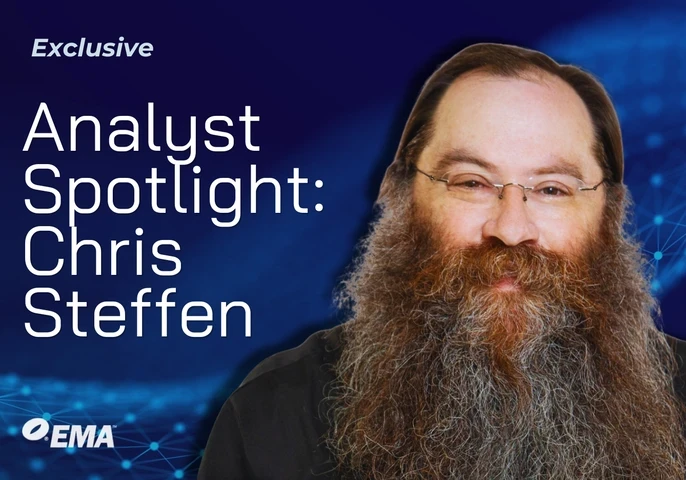
I sat down with Dan Twing, President & COO and Principal Analyst for Intelligent Automation at Enterprise Management Associates (EMA), to discuss the technologies reshaping enterprise operations.
With more than four decades of experience in enterprise IT, Twing brings a long-term perspective to the current AI transformation, exploring everything from the Enterprise Control Plane and AI-driven cloud operations to agentic AI, identity, digital transformation, and the future of enterprise architecture.

Throughout our conversation, one idea surfaced repeatedly: the next challenge isn't simply making technology more intelligent. It's learning how to coordinate, govern, and trust that intelligence at enterprise scale.
Enterprise IT to Intelligent Automation
With more than 40 years in enterprise IT and two decades as President & COO of EMA, Twing has watched enterprise technology evolve through multiple waves of transformation.
Today, his focus is on understanding how AI is bringing together disciplines that have historically operated separately, from automation and orchestration to cloud operations and infrastructure management.
“I’ve spent more than 40 years in enterprise IT and have served as President & COO of Enterprise Management Associates (EMA) for the past two decades. As Principal Analyst for Intelligent Automation, I focus on how enterprise operations are evolving as automation, AI, cloud platforms, and orchestration continue to converge.
Over the course of my career at EMA, I’ve conducted research across workload automation and orchestration, cloud computing and cloud operations, and broader enterprise infrastructure management. Today, my work focuses on how those disciplines are being reshaped by AI. That includes research into the Enterprise Control Plane, AI-driven cloud operations, AI-assisted Site Reliability Engineering (AI SRE), intelligent infrastructure management, and the impact AI is having on software development. While these may seem like separate topics, they’re increasingly converging as enterprises look to coordinate intelligent systems across complex hybrid environments.”
That convergence is particularly important as enterprises move towards environments where AI isn't simply assisting individual employees, but becoming part of the infrastructure responsible for running the business.
Why the Enterprise Control Plane Matters
For decades, organisations have used automation to streamline individual tasks and workflows. But as intelligent systems begin operating across multiple technology domains, the challenge becomes less about automating individual processes and more about coordinating everything happening around them.
“The work I’m most excited about is our research into the Enterprise Control Plane. For decades we’ve automated tasks, applications, and workflows. The next challenge isn’t simply automating more work—it’s coordinating intelligent systems operating across multiple domains while maintaining operational trust.
At the same time, we’re conducting research into how AI is transforming cloud operations. AI is changing how infrastructure is provisioned, monitored, optimised, and remediated. We’re seeing the emergence of AI-assisted Site Reliability Engineering, autonomous operational workflows, and intelligent cloud management platforms. I’m equally interested in how AI is reshaping software development itself, allowing developers to move faster while creating new challenges around governance, quality, and operational readiness.”
As AI becomes embedded across cloud, infrastructure, security, development, and operations, enterprises will increasingly need systems capable of coordinating those intelligent capabilities rather than managing them in isolation.
From Executing Instructions to Making Decisions
One of the biggest shifts happening across enterprise technology goes beyond simply the adoption of AI and focuses on the changing role of software itself.
Historically, enterprise software has largely been designed to execute predefined instructions. Increasingly, intelligent systems are being trusted to participate in decision-making.
When Vector RAG Stops Working
Why retrieval strategy now hinges on matching Vector, Graph and hybrid RAG to the questions AI must answer across complex enterprise data.
“The biggest shift isn’t simply the adoption of AI—it’s the transition from software that executes instructions to software that increasingly participates in operational decision-making. Organisations are moving beyond automating repetitive tasks toward delegating decisions to intelligent systems.
That changes everything. Success is no longer determined solely by how intelligent a system is, but by whether it can be operationalised and trusted to make consequential decisions in production. That requires far more than sophisticated AI models. It requires sufficient state awareness, trusted operational execution, clear authority, and the ability to coordinate decisions across complex enterprise environments. Intelligence is becoming a prerequisite; operational trust is becoming the differentiator.”
As enterprises give AI greater authority, technical capability alone isn't enough. Organisations need to understand what an AI system knows, what it is allowed to do, and how its decisions fit within the wider operating environment.
Agentic AI: The Real Challenge Is Scale
Agentic AI is naturally at the centre of this transformation. Systems that can plan, coordinate, and complete work are attracting significant attention.
The real challenge emerges when organisations attempt to move beyond individual use cases and deploy agents across the enterprise.
“Agentic AI is clearly receiving the most attention, and I believe the attention is justified. The industry is moving toward systems that don’t simply generate information but can plan, coordinate, and complete work.
Agentic AI becomes much more challenging as organisations move from individual use cases to enterprise-scale operations. Many domains are successfully embedding AI within their own environments, but business processes rarely stay confined to a single domain. As workflows span cloud infrastructure, applications, security, data platforms, and business operations, enterprises need a way to coordinate autonomous decisions across those boundaries. That’s where the real challenge begins—not building intelligent agents, but operationalising them with sufficient state awareness, trusted authority, and coordinated execution across the enterprise.”
Inside the Agentic SOC Stack
See how unified telemetry, correlation engines and agentic AI workflows rebuild SOC architecture for autonomous detection and response.

The distinction is important. Building an intelligent agent may be relatively straightforward compared with integrating that agent into a complex enterprise environment where its decisions can affect multiple systems and business functions.
Enterprise-Wide Coordination Could Become the Competitive Advantage
As individual technology domains become increasingly intelligent, the next challenge will be getting those systems to work together.
“Organisations should be paying much closer attention to enterprise-wide coordination. Many enterprises have successfully automated individual technology domains. The next challenge is coordinating intelligent decisions across cloud platforms, applications, infrastructure, security, development, and business operations. As AI becomes embedded throughout the enterprise, coordination becomes just as important as intelligence.
The real competitive advantage won’t come from deploying more AI models—it will come from enabling them to work together within a trusted operational architecture that can coordinate decisions across the enterprise.”
The AI Conversation Has Shifted From Capability to Trust
The industry's conversation around AI has already changed significantly over the past year.
Early discussions largely focused on productivity and generative capabilities. Now, as enterprises move towards operational deployment, the questions are becoming considerably more difficult.
“A year ago, most conversations focused on AI’s ability to improve productivity and generate content. Today, the discussion has shifted toward operational deployment. Organisations are asking much more practical questions. Which decisions should AI make? Which should remain with people? How do we validate AI-generated actions? How do we govern autonomous systems? How do we demonstrate accountability?
The conversation has matured from capability to operational trust.”
The Digital Transformation Work Isn't Finished
Despite the rapid acceleration of AI, Twing believes organisations shouldn't lose sight of an uncomfortable reality: many haven't finished the digital transformation journeys they began years ago.
Instead, some are now attempting to layer AI and intelligent agents onto fragmented environments that still contain legacy applications, disconnected workflows, and complex operating models.
The AI Value Gap Boards Now See
Escalating AI budgets are colliding with thin ROI. Explore why agentic AI heightens risk and why value oversight is becoming mandatory.
“Many organisations are still wrestling with the unfinished work of digital transformation. While AI has become the industry’s primary focus, the reality is that many enterprises never fully completed the modernisation of their applications, workflows, operating models, and data. Instead of finishing that journey, many have shifted their attention toward embedding AI and intelligent agents on top of environments that remain fragmented and operationally complex.
That creates a unique challenge. Organisations are simultaneously trying to complete digital transformation, adopt AI, redesign workflows around intelligent agents, and introduce reasoning into operational decisions. Those aren’t independent initiatives—they fundamentally change how enterprise systems are designed and managed. The organisations that succeed won’t simply layer AI onto existing complexity; they’ll rethink how work is coordinated across the enterprise, allowing modernisation and intelligent automation to evolve together rather than as separate transformations.”
Enterprises need to modernise their foundations while simultaneously experimenting with technologies that could fundamentally change how those foundations operate.
What Makes AI Adoption Successful?
While AI may introduce new complexities, Twing argues that many of the fundamentals of successful technology adoption remain unchanged.
Executive sponsorship, clear business outcomes, process redesign, user adoption, ownership, and change management continue to matter. What has changed is the nature of the technology being introduced.
“The fundamentals of successful technology adoption haven’t changed. Organisations still need executive sponsorship, clear business outcomes, process redesign, user adoption, operational ownership, and disciplined change management. Those best practices remain just as important today as they were before AI.
Security Becomes Business-Ready
Why boards must treat cybersecurity as an adaptive business capability, balancing AI adoption, identity control and resilience-by-design.

What’s different with AI is that we’re no longer deploying systems that simply execute deterministic processes. We’re introducing systems capable of reasoning, making recommendations, and increasingly making or influencing operational decisions. That changes the adoption challenge significantly. Organisations must now determine what level of data quality is required, what context is sufficient for intelligent recommendations, and, for consequential operational decisions, what broader state awareness is necessary before AI can be trusted to act. They must also determine where human oversight remains appropriate, how autonomous decisions are coordinated across technology domains, and how outcomes are validated once those decisions move into production. We’ve spent decades learning how to deploy deterministic systems. Now we’re learning how to operationalise reasoning systems, and that requires an entirely new level of operational discipline.”
The shift from deterministic systems to reasoning systems therefore introduces a fundamentally different adoption challenge. Enterprises aren't simply deploying technology that follows instructions; they're introducing technology capable of interpreting context and influencing decisions.
Identity Is Becoming the Foundation of Trusted Autonomy
As AI agents and autonomous workflows become more common, identity is also taking on a broader role.
Twing believes organisations need to think beyond traditional questions of authentication and access. As machines begin acting on behalf of people and organisations, enterprises need to understand not only who is acting, but what authority those systems have.
“Many organisations still view identity primarily as a cybersecurity concern—something focused on authenticating users and controlling access. While that's still essential, AI is expanding the role of identity far beyond traditional security. As enterprises deploy AI agents, autonomous workflows, APIs, and machine-to-machine interactions, non-human identities are growing rapidly and participating in operational decision-making.
That means identity is becoming foundational to trusted autonomy. Enterprises need to know not only who—or what—is acting, but what authority it has, what decisions it is permitted to make, what operational state it can access, and how those actions are governed and audited. As AI becomes more autonomous, identity evolves from a security control into a core component of enterprise trust and operational governance.”
This could make identity one of the defining foundations of enterprise AI. If organisations can't establish what an autonomous system is allowed to do, they can't confidently give that system greater operational authority.
Humans Aren't Going Anywhere
The growing autonomy of AI has inevitably prompted questions about what role humans will play in the enterprise of the future.
Twing is sceptical of predictions that widespread human displacement is inevitable. Instead, he sees AI following a pattern established by previous waves of automation: taking over repetitive work while allowing people to focus on activities that require judgement, creativity, and expertise.
“I think predictions of widespread human displacement are probably overstated, much as they have been with previous waves of enterprise automation. Historically, successful automation has been less about eliminating people and more about shifting them away from repetitive, low-value activities toward work that requires judgment, creativity, and business expertise. I expect AI to follow a similar pattern, although its impact will ultimately be broader because it brings reasoning into areas that were previously difficult to automate.
In the near term, AI will increasingly act as a collaborator—assisting with investigations, identifying patterns, generating recommendations, and helping people make better decisions faster. Over time, I do believe AI will assume a growing share of operational decision-making, but only where organisations can demonstrate that those decisions are consistently reliable and appropriately governed. That means measuring how often human experts agree with AI, where they override it, and whether those interventions improve outcomes. As confidence grows, humans will spend less time making routine operational decisions and more time defining policy, handling exceptions, improving processes, and governing increasingly autonomous systems. The goal isn’t to remove people from the enterprise—it’s to ensure they’re contributing where they create the greatest value.”
Rather than eliminating humans from enterprise operations, the shift could therefore see employees move further upstream—towards setting policy, managing exceptions, improving processes, and overseeing increasingly autonomous systems.
Watching the Convergence of AI and Enterprise Operations
Looking ahead, Twing is particularly interested in what happens as AI becomes embedded across multiple operational domains.
Cloud operations, observability, orchestration, infrastructure management, software development, and security are all becoming increasingly intelligent in their own right. The next challenge will be coordinating those capabilities.
“I’m watching the convergence of AI with enterprise operational platforms and what that means for the future of enterprise coordination. AI is rapidly becoming embedded within cloud operations, observability, orchestration, infrastructure management, software development, and security. Each of those domains is becoming capable of making intelligent recommendations and, in many cases, taking autonomous action within its own operational scope.
What I’m watching most closely is what happens when those autonomous capabilities begin interacting across the enterprise. Business processes rarely stay within a single technology domain. Provisioning infrastructure affects applications. Security events impact operations. Development pipelines trigger deployment and orchestration workflows. As intelligent systems begin making decisions across those boundaries, enterprises will need new ways to coordinate actions, establish trusted authority, ensure the appropriate level of data quality, context, and, where consequential operational decisions are involved, sufficient state awareness, and govern autonomous execution across the entire operating environment. I believe that’s where the Enterprise Control Plane becomes important—not as another management console, but as the coordination and governance layer that enables trusted enterprise-wide operational decision-making.”
What Will Define the Next Era of Enterprise Technology?
The future of enterprise technology isn't simply about building increasingly powerful AI models.
The real differentiator will be whether organisations can operationalise that intelligence safely, consistently, and at scale.
“I don’t think the next era will be defined simply by more capable AI models. It will be defined by an enterprise’s ability to operationalise intelligence safely and consistently. That means governing how intelligent systems make decisions, ensuring they have sufficient data quality, context, and—where consequential operational decisions are involved—the necessary state awareness to act with confidence. Organisations that master trusted operational decision-making will realise far greater value from AI than those that simply deploy more models.
At the same time, I’m watching another important shift in cloud infrastructure strategy. Before AI accelerated, we had begun to see the early stages of workload repatriation as organisations reconsidered where applications and data should reside. That conversation largely paused as enterprises rushed to understand generative AI, token-based pricing, and new deployment models. I believe we’ll see renewed pressure toward selective workload repatriation, driven in part by the need to augment foundation models with proprietary enterprise data, optimise performance, manage inference costs, and retain greater control over strategic AI capabilities. That doesn’t mean hyperscalers become less important—they’ll remain foundational—but I do think many enterprises will reevaluate where intelligence is hosted and how closely it should reside to the data that gives it business value.
Ultimately, I believe the next generation of enterprise architecture will be defined by two complementary capabilities: coordinating intelligent decisions across increasingly autonomous operational domains while ensuring those decisions are made where enterprises can best govern, enrich, coordinate, and trust them. That’s the direction my current research is exploring through both the Enterprise Control Plane and the evolution of AI-driven cloud operations.”
Final Thoughts
When you look across the conversation, Dan Twing's perspective on the future of enterprise technology is ultimately less about AI replacing existing systems and more about AI changing how those systems work together.
The enterprise is moving from automation towards intelligent decision-making. Agents are becoming more autonomous. Infrastructure is becoming increasingly intelligent. And software is beginning to play a more active role in operational decisions.
But with that evolution comes a new responsibility: ensuring those decisions can be trusted.
The next era of enterprise technology will belong to organisations that can coordinate intelligent systems across increasingly complex environments while maintaining the governance, context, authority, and human oversight needed to operate them safely.
The challenge, then, isn't simply building smarter technology. It's building an enterprise capable of trusting it.


Comments ( 0 )